
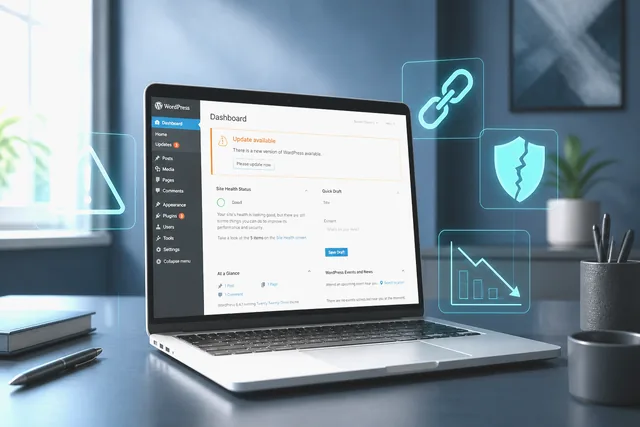
“The site still opens — why touch it?” Many business owners think this way. It is understandable: there are sales, clients, and a team to run. WordPress updates, plugins, and forms feel like minor details.
But a website is not a piece of furniture you install and forget. It is a living system: software for pages, enquiry forms, protection against break-ins, and connections to email and payment services. If you do nothing for years, problems build up — often invisibly, until it is too late.
In this article we explain in plain terms what can happen to your site and business if you ignore updates and regular technical care.
1. Your site can be hacked
An outdated WordPress version and old plugins are like unlocked doors. Attackers automatically scan for exactly these sites: they are easier to hijack, inject malicious code into, use for spam from your address, or show visitors someone else’s advertising.
What this looks like in practice
You may not notice a break-in for weeks. The site “opens” as usual, but foreign code is already running inside. Then comes a letter from your hosting provider, blocked corporate email, or complaints from clients. Recovery takes time and costs far more than regular website security maintenance.
2. Enquiries stop reaching you
The “Send enquiry” form depends on dozens of small things: email delivery, spam protection, SSL certificate, server settings. After a browser or hosting update, old forms often stop working silently.
Why this goes unnoticed
You look at traffic stats — “lots of visits” — but the phone stays quiet. The cause is not always advertising. Sometimes the button on your site is simply dead, and you spend budget attracting people who cannot contact you.
3. The site suddenly breaks or fails on mobile
A new iPhone, updated Chrome, hosting changes — and the layout shifts, the menu stops responding, the cart will not open. Old code was not built for modern devices and standards.
A client opens your site on their phone, sees a mess — and goes to a competitor. You may never know how many people did the same.
4. Google and the browser show warnings
If a virus, outdated SSL, or unsafe link is detected on your site, Google may show a warning. Chrome sometimes displays a large red screen: “Dangerous site”.
What this does to trust
Trust drops instantly. Even regular clients will hesitate to leave a phone number or email. Rebuilding reputation in search is harder than keeping the site in order from the start.
5. The site slows down — fewer enquiries and sales
Without updates and cleanup, extra files, old images, and heavy plugins accumulate. Pages load longer. Most people do not wait: a few seconds and they close the tab.
A slow site is not just inconvenient. It means fewer enquiries, fewer purchases, and weaker positions in Google — even when your product and price are exactly right. More on this in our article on website speed.
6. Online store: orders lost or payment fails
For a shop, updates are critical: cart, payment, delivery, stock levels. Old WooCommerce or payment module versions often conflict with new bank rules.
One broken step costs money every day
A client adds a product, reaches “Pay” — and nothing happens. You lose revenue daily, not just once. That is why e-commerce site maintenance cannot be postponed.
7. You cannot change text or prices yourself
“I used to update prices myself — now the editor will not open.” This happens when neither WordPress nor the page builder (Elementor and others) has been updated for years.
Every small edit becomes an urgent call to a developer — even to change one paragraph or a photo in a slider.
8. Recovery after a crash costs many times more
Regular care means small steps: updates, backups, form checks. Emergency recovery after a hack or white screen means hours of investigation — sometimes rebuilding from scratch.
Saving on maintenance often turns into a bill several times larger.
9. The site looks outdated — clients choose competitors
A ten-year-old design next to modern sites feels obvious at once. People unconsciously think: “If the site is old — maybe the company is not keeping up either.”
Updates are not only about security. Sometimes you need a redesign or at least a refresh of key blocks.
10. Risks to client data (GDPR and EU/US)
If you collect names, phone numbers, and email on your site — you are responsible for protecting them. Outdated forms, a cookie banner “for show”, missing backups — in an incident this is a risk to reputation and penalties on EU and US markets.
Current updates, HTTPS, and proper settings are part of responsible website management, especially if you work with European and American clients.
What to do instead of “leave it alone”
You do not need to learn the technical side yourself. It is enough to agree on regular care for the site:
— WordPress and plugin updates (carefully, with a backup);
— checking forms and email — do enquiries arrive;
— backups in case of failure;
— basic protection against break-ins and spam.
We offer this as website security and stable operation — after launch you can hand the technical part to us while you focus on the business.
It also helps to read: how to choose reliable hosting, why website speed matters, and what redesign involves — in our blog.
Summary
“Do not touch it while it works” is the most expensive strategy. Hacking, lost enquiries, Google warnings, a broken shop, and a sudden recovery bill are real consequences of not updating your website.
Message us in your preferred messenger or fill in the form. Share your ideas — we will suggest the best approach, calculate cost, and outline a timeline.